If someone asked you right now:
“How many active subscriptions are you paying for?”
Would you confidently answer?
Most people cannot.
They might guess. They might estimate. But very few know the exact number.
And that is exactly the problem.
<Callout type="danger" title="Hard Truth"> Most consumers underestimate their subscription count and spending by more than 2x. </Callout>In this guide, you will complete a structured 30-minute subscription audit to uncover:
- Hidden recurring charges
- Forgotten free trials
- Duplicate services
- Annual subscriptions about to renew
- Zombie accounts you no longer use
By the end, you will know exactly how many subscriptions you have and what they are truly costing you.
Why Subscription Audits Matter
Subscriptions feel small.
$9.99 per month.
$14.99 per month.
$29 per month.
Individually manageable. Collectively expensive.
Recurring payments are designed to be invisible. Once auto-pay is enabled, they disappear into the background.
Over time, this creates:
- Budget blind spots
- Financial drift
- Cognitive overload
- Subscription creep
With the average American now spending $219 per month on subscriptions, many users solve this by using a subscription tracker without bank linking, which allows for an audit of all services without surrendering private bank login credentials.
Once you know your number, you should compare the best subscription trackers of 2026 to find the tool that fits your specific privacy and automation needs.
<Callout type="warning" title="Annualization Effect"> Five unused subscriptions at $15 per month equals $900 per year. </Callout>A subscription audit restores visibility.
<BlogCTA title="Run Your Audit Instantly" description="Don't waste 30 minutes searching bank statements. SubDupes finds your subscriptions from receipt confirmations automatically and privately." />
The 30-Minute Subscription Audit Framework
You will complete this in five structured phases.
Set a timer for 30 minutes.
Open:
- Your bank app
- Your credit card statements
- Your email inbox
Let us begin.
Phase 1: The 90-Day Bank Statement Scan (10 Minutes)
Open your last 90 days of bank and credit card transactions.
You are looking for patterns.
What to Look For:
- Identical amounts recurring monthly
- Charges ending in .99 or .95
- Merchant names repeating
- Small charges you barely notice
Search your statement for keywords:
- Subscription
- Membership
- Recurring
- Bill
- Premium
- Plus
Create a quick list:
- Service name
- Amount
- Billing frequency
Do not evaluate yet. Just list.
Phase 2: Annual Subscription Detection (5 Minutes)
Many subscriptions do not bill monthly.
They bill annually.
These are harder to detect because they appear only once per year.
Scan for:
- $99
- $119
- $149
- $199
- $249
- $299
Common annual services include:
- Software licenses
- Cloud storage upgrades
- Domain renewals
- Professional memberships
- Security tools
Mark any annual services clearly.
Phase 3: Email Inbox Subscription Sweep (5 Minutes)
Your inbox contains hidden subscription intelligence.
Search for:
- “trial ending”
- “renewal notice”
- “payment confirmation”
- “subscription renewed”
- “invoice”
- “order receipt”
Look especially for:
- Free trial confirmations
- Discount expiration emails
- Price increase notifications
Add any newly discovered subscriptions to your list.
Phase 4: App Store & SaaS Account Review (5 Minutes)
Mobile subscriptions often bypass your memory.
Check:
iPhone:
Settings → Apple ID → Subscriptions
Android:
Google Play → Payments & Subscriptions
Also check:
- SaaS dashboards
- Business tools
- AI platforms
- Online learning accounts
Freelancers and professionals often have:
- Duplicate SaaS accounts
- Expired project tools
- Overlapping software tiers
Phase 5: Categorize and Evaluate (5 Minutes)
Now count.
How many subscriptions did you find?
10?
20?
30+?
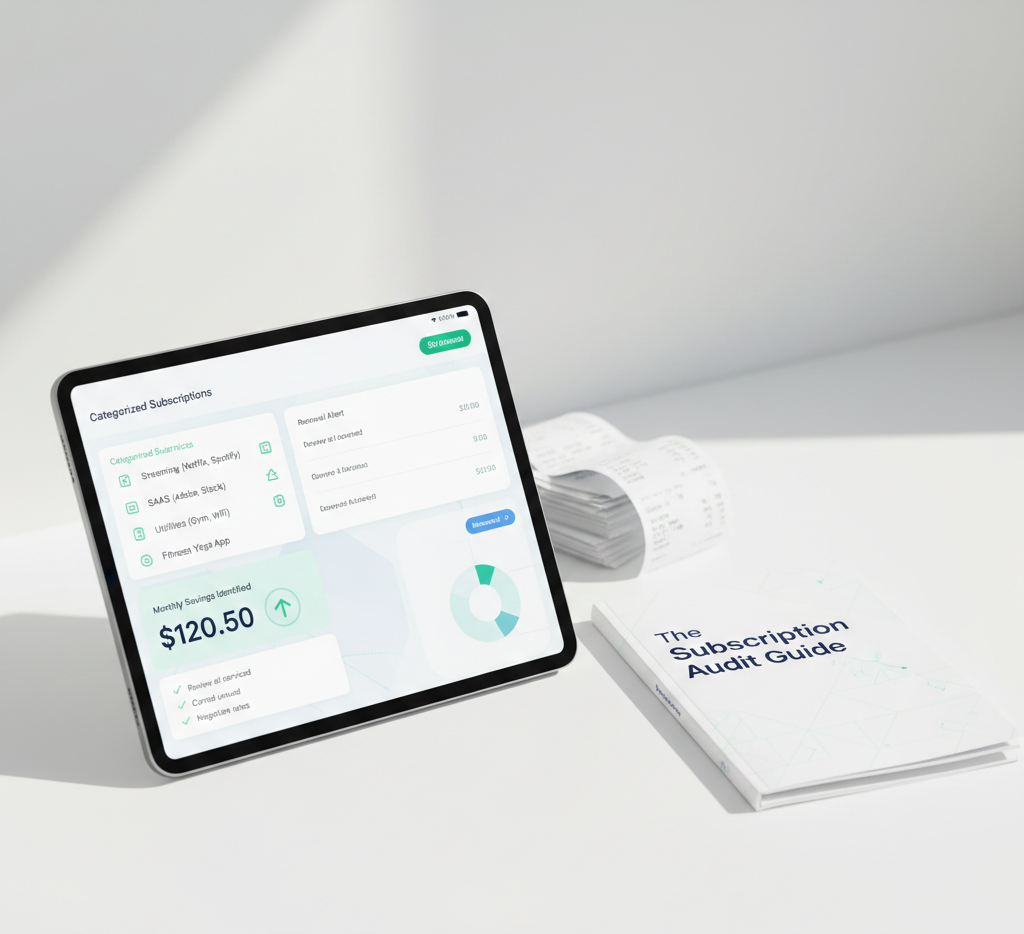
Now categorize them:
Essential
You use regularly and would immediately notice if canceled.
Rotational
Useful occasionally. Can be paused or rotated.
Zombie
You have not used in 60–90 days.
<Callout type="danger" title="Immediate Action Rule"> If you have not used a service in 90 days, it likely qualifies for cancellation. </Callout>The Real Question: What Are They Costing You?
Now calculate.
Add:
- Total monthly subscription cost
- Total annual subscription cost
- Grand yearly total
Most people experience one of two reactions:
- Shock
- Mild panic
That is normal.
Subscription accumulation is gradual.
Common Subscription Audit Discoveries
After running thousands of subscription evaluations, patterns emerge.
1. Duplicate Tools
- Two cloud storage providers
- Multiple streaming services
- Overlapping AI tools
2. Expired Project Software
Design tools kept after a freelance contract ends.
3. Legacy Hosting or Domains
Old websites still billing quietly.
4. Premium Tiers Never Downgraded
You upgraded for one feature and never reverted.
How to Prevent Subscription Drift Going Forward
Auditing once is powerful.
Maintaining visibility is better.
You have three options:
Option 1: Manual Spreadsheet
Track everything manually.
High effort. Prone to drift.
Option 2: Bank-Linked Subscription Apps
Automated but requires full transaction access.
Higher convenience. Higher data exposure.
Option 3: Privacy-First Subscription Tracker
A middle ground.
SubDupes allows you to:
- Detect subscriptions from receipt confirmations
- Track renewal dates
- Monitor price changes
- Maintain visibility without linking your bank
The 3-Month Rule
Schedule a subscription audit every 90 days.
Quarterly reviews help you:
- Catch price increases
- Identify unused tools
- Rotate streaming services
- Reduce digital clutter
Financial hygiene compounds over time.
Final Thoughts
Most people do not know how many subscriptions they have.
That is not a failure. It is a design outcome of the subscription economy.
The real mistake is never checking.
In 30 minutes, you can:
- Identify hidden recurring charges
- Cancel zombie subscriptions
- Save hundreds or thousands annually
- Reduce financial stress
<BlogCTA variant="accent" title="Maintain Absolute Visibility" description="Audits shouldn't be a chore. Centralize your services, track every renewal, and keep your budget airtight with SubDupes." />
<Callout type="danger" title="Final Reminder"> Visibility precedes control. If you cannot see your subscriptions clearly, you cannot manage them effectively. </Callout>Run the audit.
Count them.
Then decide intentionally which deserve to stay.