In an era defined by software convenience, our bank accounts have become leaky buckets. We sign up for a trial, forget to cancel, upgrade a user seat for a contractor who left six months ago, and shrug off small $10 charges as "insignificant." But recurring software costs are the number one silent killer of personal and business profitability. You aren't just losing pocket change; you are paying an invisible, compound tax to SaaS corporations that rely entirely on your inattention to fund their bottom lines.
In this definitive, privacy-first master guide, we provide a blueprint to find, audit, and consolidate recurring charges, maintaining a lean budget without sharing your bank credentials.
The Financial Math of Subscription Creep
Most consumers underestimate how many active subscriptions they pay for. The typical digital professional manages dozens of tools across different cards, emails, and payment checkouts. Look at how micro-transactions accumulate:
Because these charges are distributed across different cards and billing cycles, the total sum is almost always obscured. The table below details the cumulative math of small monthly payments:
| Number of Active Subscriptions | Average Monthly Item Cost | Total Monthly Spend | Total Annual Spend |
|---|---|---|---|
| 5 Subscriptions | $15.00 | $75.00 | $900.00 |
| 10 Subscriptions | $20.00 | $200.00 | $2,400.00 |
| 15 Subscriptions | $25.00 | $375.00 | $4,500.00 |
| 20 Subscriptions | $30.00 | $600.00 | $7,200.00 |
| 35 Subscriptions (Agency Stack) | $45.00 | $1,575.00 | $18,900.00 |
Behavioral researchers note that consumers are 80% less likely to audit or cancel charges under $20/month. SaaS companies study this threshold, pricing tools at $9.99 or $19.99 to encourage passive retention. Force yourself to review and justify every subscription under $20 with the same scrutiny as a major software purchase.
The Three Primary Billing Traps
SaaS marketing and growth teams optimize sign-up paths while retention teams build barriers. This has led to the adoption of three common grey billing practices:
- Silent Trial Conversions: Free trials convert to paid plans on day 8. Many companies convert trials into annual contracts ($150-$200) instead of monthly ones to maximize cash flow upfront.
- Unannounced price hikes: Services quietly raise rates from $10 to $13. They bury these updates in newsletters, relying on user inertia to secure higher margins across millions of accounts.
- Ghost User Seats: In team environments, admins add contractor seats for temporary projects. When the contractor leaves, their user profile is deactivated—but the billing seat remains active, charging you month after month.
Traditional subscription managers require you to connect your bank accounts via Plaid or Finicity. To show you a simple list of software renewals, these apps ingest your entire financial history—including checking account balances, direct deposits, rent payments, and shopping logs. Keep your passwords secure and choose receipt-based trackers.
The 4-Step Subscription Audit Framework
Audit and clean your digital budget in under 30 minutes using this systematic roadmap:
-
Step 1: The Inbox Receipt Sweep (10 Minutes): Search your email archives for keywords like
"receipt" OR "invoice" OR "your subscription". Compile a list of all active software names, prices, and renewal dates. -
Step 2: The Card Statement Filter (10 Minutes): Download the last 90 days of transactions from your credit cards as a CSV file. Sort by "Transaction Description" and identify repeating payment sequences. Look up any cryptic codes starting with
SP *,DRI*, orPADDLE. -
Step 3: The Mobile Portal Audit (5 Minutes): Access Apple ID subscriptions (under Settings > [Name] > Subscriptions) or Google Play Console (under Payments & Subscriptions) to verify what apps are auto-billing your phone.
-
Step 4: The Prune and Consolidate Phase (5 Minutes): Group all subscriptions into: Keep (active weekly use), Cancel (unused or redundant), and Consolidate (upgrade active tools from monthly to annual plans to save 20%).
How SubDupes Secures Your Subscription Budget
**SubDupes** replaces manual spreadsheets with private, automated tracking:
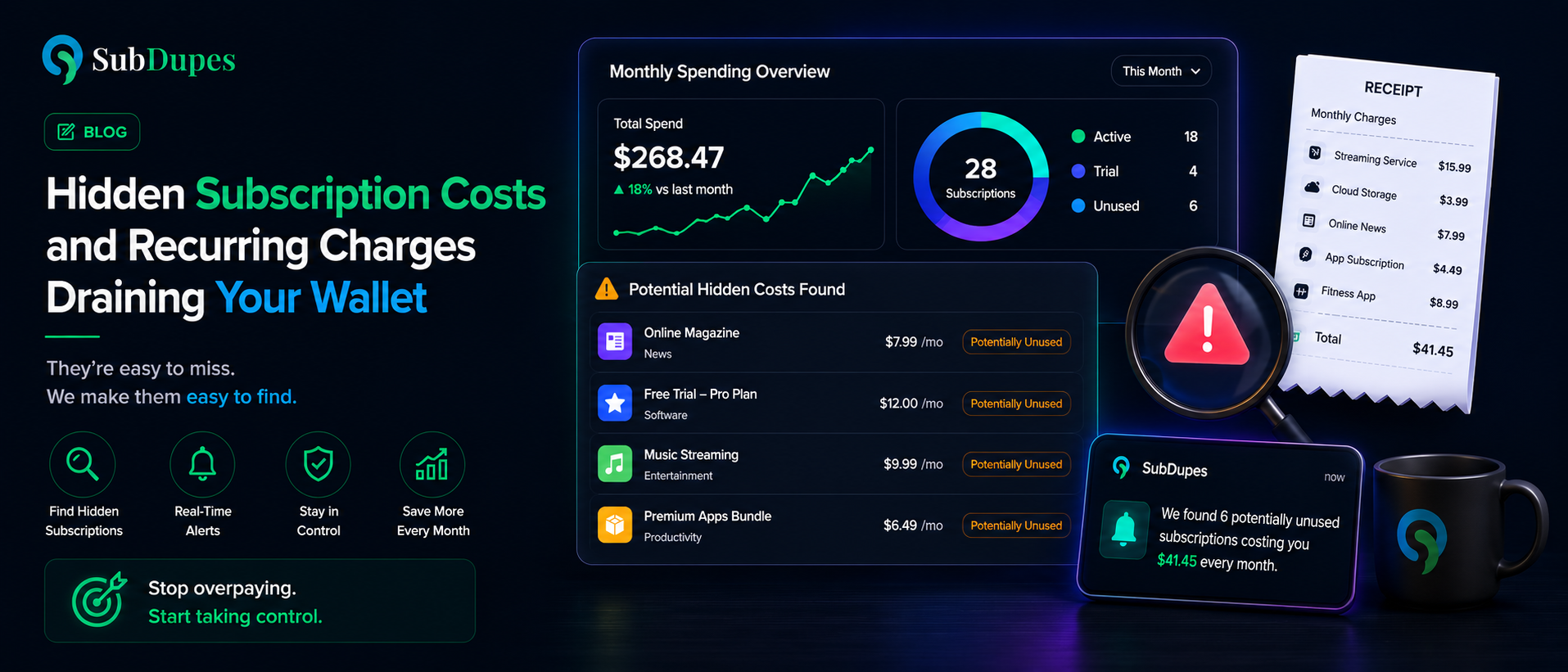
- Read-Only Receipt Scrapes: SubDupes watches your connected email inbox for transaction receipts and invoice confirmations, parsing them to build your ledger.
- No Bank Account Sync: Your checking accounts, balances, credit card numbers, and login passwords remain completely offline.
- Pre-Billing SMS Notifications: Receive countdown warning alerts 14 days before renewals occur, giving you time to cancel trials before they convert.
- Duplicate Tool Mapping: The system categories your tools and alerts you if you pay for duplicate cloud storage or overlapping project boards.
Studio East was paying for 18 active software tools across three credit cards. By transitioning their tracking to SubDupes, they consolidated duplicate file sharing servers and terminated five ex-employee accounts, immediately reducing their software overhead by $320 per month ($3,840/year).
Frequently Asked Questions
Expose hidden recurring charges.
Track your renewals, spot duplicate software, and manage your billing cycles without bank access. Start your free private audit today.
Start Free Audit Now