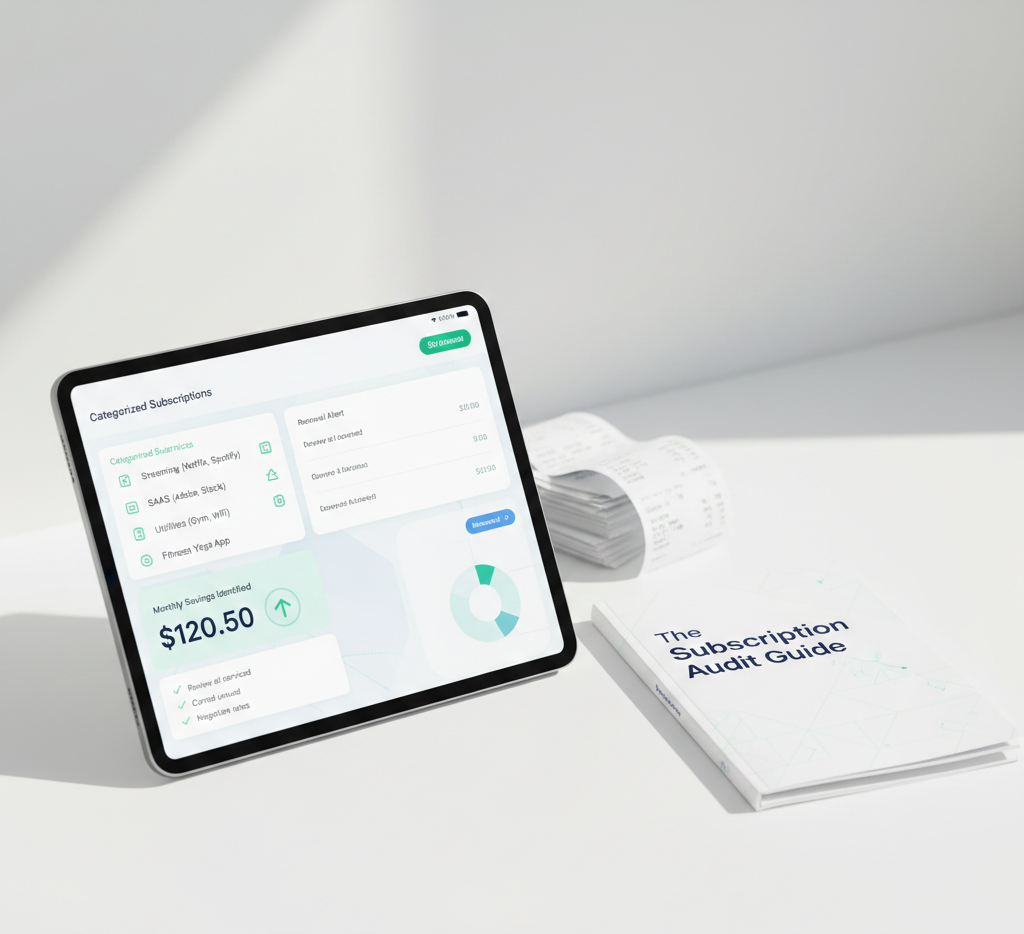
You don't wake up one day and decide to spend $300 or $400 a month on subscription software and entertainment. It happens gradually, almost imperceptibly. A streaming platform here, an ad-free music tier there, a cloud storage upgrade, a delivery app pass, a premium newsletters sub, and an AI-powered writing assistant. Individually, each charge is negligible—amounting to less than a single restaurant lunch. Collectively, however, they form a massive structural drain on your monthly budget.
This phenomenon is known as Subscription Creep (or subscription sprawl). In this guide, we explore the behavioral economics that make subscription creep so effective, look at the compounding cost of minor fees over time, and provide actionable strategies to block cash leaks before they damage your financial goals.
The Illusion of the Low-Cost Monthly Charge
Subscription models are highly lucrative for companies because they leverage a psychological phenomenon known as Payment Smoothing. By breaking down a large annual cost into small monthly installments, companies lower your brain's natural "pain of paying." Your cognitive resistance to spending $9.99 per month is significantly lower than spending $120 upfront, even though the net economic cost is identical.
When you stack ten of these minor charges, they quietly morph into a major budget category. Let's look at the compounding math of small monthly charges over various time horizons:
| Monthly Fee | 1-Year Cost | 3-Year Cost | 5-Year Cost | 10-Year Cost |
|---|---|---|---|---|
| $4.99 (Storage/App) | $59.88 | $179.64 | $299.40 | $598.80 |
| $14.99 (Streaming/Music) | $179.88 | $539.64 | $899.40 | $1,798.80 |
| $29.99 (Fitness/SaaS) | $359.88 | $1,079.64 | $1,799.40 | $3,598.80 |
| $79.00 (Combined Stack) | $948.00 | $2,844.00 | $4,740.00 | $9,480.00 |
When you look at a combined subscription stack costing $79 a month, you are looking at nearly $10,000 lost over a decade. If that money were invested in an index fund yielding a conservative 7% annual return, it would grow to over $13,500. Subscription creep doesn't just cost pocket change; it directly steals from your long-term wealth creation.
To calculate if a subscription is actually worth keeping, divide the monthly fee by the number of times you actively used the service in the last 30 days. If you pay $15/month for Netflix and watch it 20 times, your cost-per-use is $0.75 (high value). If you pay $30/month for a fitness platform and log in once, your cost-per-use is $30 (extremely low value). Cancel any service with a cost-per-use higher than a single movie ticket.
The Behavioral Drivers of Subscription Accumulation
Why do smart people allow subscription creep to persist? It boils down to four primary psychological barriers:
- Status Quo Bias: Human beings default to doing nothing. When canceling a subscription requires logging in, navigating complex menus, and answering exit surveys, we choose the path of least resistance: leaving the subscription active.
- "Just in Case" Mentality: We keep subscriptions active because we convince ourselves we'll need them in the near future. We tell ourselves, "I might watch that show next month," or "I'll write that blog post using this AI tool soon." This aspirational bias costs us money for features we never actually consume.
- Free Trial Amnesia: Companies require credit cards for "free" trials because they know a high percentage of users will forget to cancel before the billing cycle kicks in. This converts temporary interest into permanent, passive billing.
- Functional Overlap: In the professional space, we stack tools that do the same thing. Having Slack Premium, Microsoft Teams, and Zoom active simultaneously is a prime example of functional overlap.
Subscription services frequently increase pricing by $1 to $3 per month. They notify you via tiny, easily overlooked email disclaimers. Because the increase is small, they expect you won't cancel. However, a $2 hike on 5 stacked services increases your annual outflow by $120 without adding a single ounce of new value.
Traditional Stacking vs. Smart Service Rotation
You don't need to live in digital austerity to control your budget. Instead of stacking every platform simultaneously, transition to a rotational model. Let's compare the financial and user experience differences:
| Subscription Strategy | Description | Annual Cost | Pros / Cons |
|---|---|---|---|
| Traditional Stacking | Keeping Netflix, Disney+, Max, and Prime Video active all year round. | ~$720/year | ✔ Ultimate convenience. ✘ High waste; you can only watch one screen at a time. |
| Active Rotation | Subscribing to one streaming service for 2-3 months, bingeing content, canceling, and switching to another. | ~$180/year | ✔ Saves ~$540/year; reduces option paralysis. ✘ Requires manual switching. |
How SubDupes Combats Subscription Creep
Putting an end to subscription creep requires visibility and frictionless management. **SubDupes** provides the structural checks you need to keep your budget clean:
-
Centralized Visibility: SubDupes scans your incoming emails for purchase receipts and invoices, compiling all active recurring charges in a single, clear dashboard. You no longer have to guess what you're paying for.
-
Price Modification Alerts: Our parsing engine compares your billing histories. If a vendor raises their monthly price, SubDupes highlights the change on your dashboard and calculates its annualized impact.
-
Overlap & Redundancy Detection: SubDupes categories your subscriptions. If you have two active storage providers or multiple video hosting accounts, the system suggests immediate actions to consolidate.
-
14-Day Advance Warnings: Receive a friendly text message or email 14 days before a renewal. This gives you a clear window to cancel or change tiers before you're charged.
The Millers were paying for iCloud storage, Google One, Dropbox, Spotify, Apple Music, Netflix, Hulu, Disney+, and Amazon Prime. They assumed their monthly subscription bill was around $90. After linking their receipt history to SubDupes, they discovered they were spending $218 per month ($2,616/year). By canceling redundant cloud storage, switching to a single music streaming provider, and rotating video platforms, they reduced their spend to $64 per month, saving $1,848 annually.
Frequently Asked Questions
Don't let small charges bleed your budget dry.
Bring all your monthly subscriptions into one view. Detect hidden price hikes and eliminate duplicate plans with SubDupes. Start your free, private receipt audit today.
Start Free Audit Now